
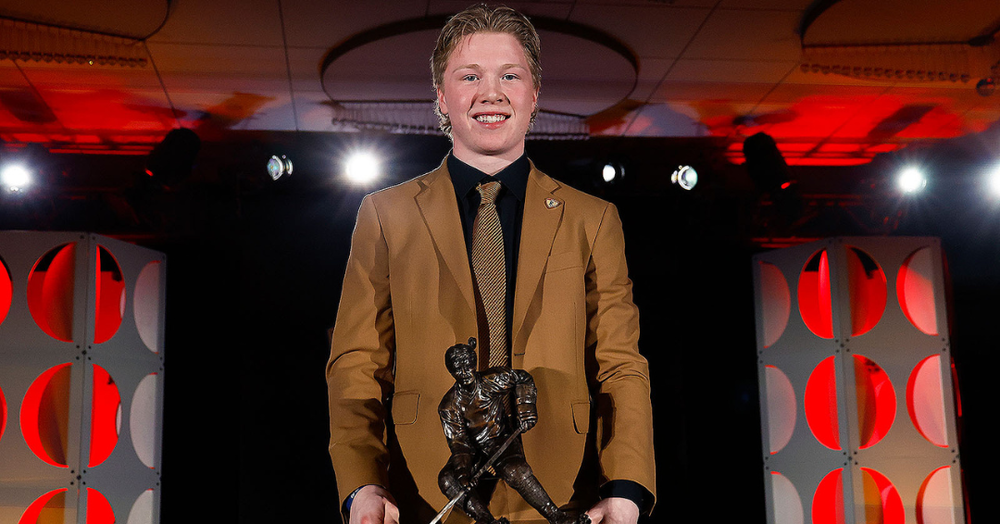
Max Plante reached the top of college hockey April 10th in Las Vegas, then spent the next few days talking about what he hasn’t finished.
That contrast — achievement on one hand, unfinished business on the other — is the clearest way to understand why the Minnesota Duluth sophomore now carries the Hobey Baker Award and why his story is not yet complete.
Plante, a Hermantown native, delivered one of the most decorated seasons in Bulldogs history and was named the 2025-26 Hobey Baker Memorial Award winner at the Presidio Ballroom at Park MGM. He became the seventh player in program history to claim the sport’s highest individual honor, reinforcing a standard inside the program that few in college hockey can match.
“It feels surreal,” Plante said. “It feels like a dream. But it is your name, and when your name’s called you, you’ve got to stand up. It was super special to look around and see my family there.”
The numbers explain the selection. The tone explains the player.
Plante finished with 52 points, the most by a Bulldogs player since 2011-12. His 26 goals ranked second nationally. He placed among the NCAA leaders in points per game, game-winning goals and power-play production, and averaged 21 minutes, 50 seconds of ice time. He recorded at least two points in 15 games, including five outings with three or more, and produced against top competition, including NCAA tournament teams.
The resume is complete. The perspective is not.
When Plante spoke publicly for the first time after winning the award, the conversation did not linger on the honor. It returned, repeatedly, to what he chose not to do — sign an NHL contract — and what he intends to pursue instead.
The decision was not framed as hesitation. It was framed as clarity.
“If I signed it, I’d be excited,” he said, “but I also maybe have a little bit of regret.”
That word — regret — carried more weight than the certainty of advancement. For a player at this level, the timeline is usually straightforward: produce, leave, move on. Plante stepped away from that path for a reason that is both simple and rare.
He has not won a national championship.
“I plan to come back next year,” Plante said. “To try to achieve something that I haven’t achieved and win a national championship. That’s kind of the goal.”
That decision reshapes the immediate future of Minnesota Duluth and elevates expectations across the National Collegiate Hockey Conference. It also reflects the environment Plante is choosing to remain part of — a program that now has seven Hobey Baker winners, the most in NCAA history.
Coach Scott Sandelin, who resides in Hermantown, has overseen four of those.
“Very deserving,” Sandelin said. “It was an important year for our program, and he was one of the catalysts to help get us back on track.”
That word — catalyst — matters more than the statistics. Minnesota Duluth did not simply produce a top player this season. It found direction again, and Plante drove it.
The return adds another layer that cannot be manufactured.
Plante will share the ice next season with both of his brothers — Zam, already in the program, and Victor, an incoming freshman. It is not being treated as novelty. It is viewed as continuity — three players shaped by the same environment, expected to play the same way.
“We’ve grown up playing the same way,” Plante said. “It’s about competing and doing what it takes to win.”
That familiarity extends beyond family. Multiple players with NHL options chose to return, independently, without coordination. In an era defined by movement, that kind of stability is uncommon.
“You don’t see that everywhere,” Plante said. “Guys want to be here, and they want to win together.”
Teams that stay intact tend to become harder to play against — not just because of talent, but because of shared understanding. Systems are cleaner. Roles are clearer. Standards are already set.
Plante will enter that structure differently next fall. The award ensures that.
He will not arrive as a rising player. He will arrive as the best player in college hockey, the one every opponent prepares for, the one every game plan accounts for. The margin for quiet nights disappears. The expectation becomes constant.
That is the tradeoff.
“If you want to be the best, you’re going to get everyone’s best,” he said. “That’s what we want.”
There is also a practical side to his return. Last offseason was limited by a pair of heart surgeries, forcing him to recover rather than build. This summer will be uninterrupted.
“I’m going to have a full summer this time,” he said. “That’s a big deal. You’re going to see another level because of that.”
For a player coming off a Hobey Baker season, that statement lands with weight. The award recognizes what already happened. It does not protect what comes next.
The easy version of this story is already written: the best player in college hockey chose to return, and Minnesota Duluth becomes a favorite.
The more accurate version is more telling: A player who just reached the top of his sport looked at the result and decided it wasn’t enough. The Hobey Baker Award did not change the standard. It clarified it.